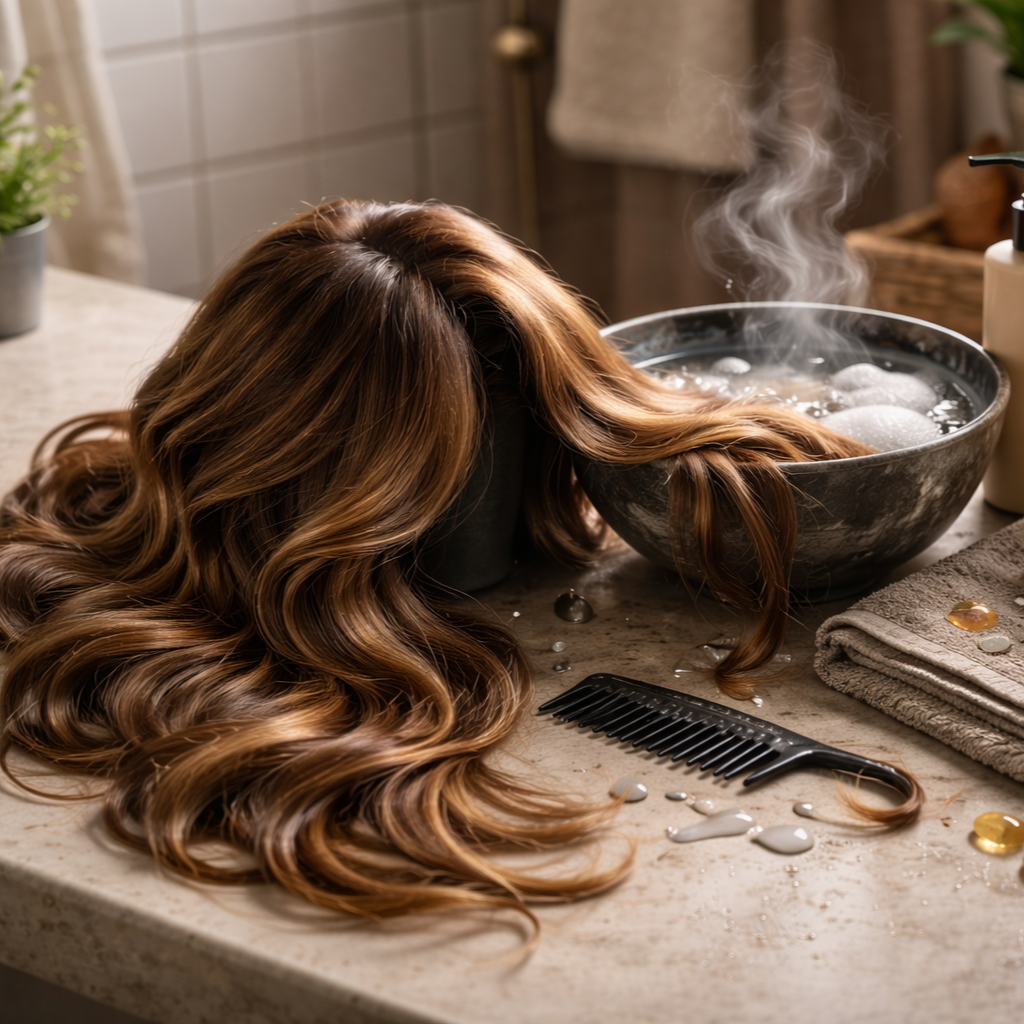
Properly caring for real hair wigs – without fear of doing something wrong
A real hair wig isn't complicated – it just needs a clear routine: gentle detangling, proper washing, smart storage, and careful heat use. Here you'll find detailed step-by-step instructions – including DIY washing.
If you prefer listening to reading
Brief overview: the most important rules, typical mistakes and the safe DIY washing routine.
Optional: Show transcript
Transcript: „"Hello and welcome. In this audio guide, I'll calmly show you, step by step, how to properly care for your human hair wig – without fear of doing anything wrong. First and foremost, the most important truth: A human hair wig isn't complicated. It simply requires a different approach than your own hair – because it's no longer nourished by the scalp. This means: no natural oil production, no moisture supply, no 'self-protection.' And that's precisely why our care rule is so simple: Gentle. Lukewarm. And always in the direction of hair growth. If you follow this, you practically can't damage anything. --- 1) Why wigs often get tangled – and why it's NOT your fault. Many people think: 'I must be doing something wrong because the wig gets tangled so quickly.' In most cases, this isn't true. The biggest enemy is friction. Scarves, coat collars, jacket fabrics, seatbelts, even a handbag on the shoulder strap – these are the typical causes of knots, especially in the nape of the neck." This means: If your wig tangles more easily at the nape of your neck, this is usually a perfectly normal everyday occurrence – and not a care mistake. What helps? A quick daily detangling and consciously protecting areas prone to friction. More on that in a moment. --- 2) The daily 5-minute routine – your "lifespan booster" The best care isn't "lots of product," but a clear routine. In the morning: Gently detangle the wig – always from the ends upwards. Don't pull it through forcefully. If there's a knot: first loosen it with your fingers, then continue combing. For curls: Please don't brush them like normal hair. Instead, detangle curls with your fingers or a wide-tooth comb – very carefully. In the evening: Check again briefly: Are there any small knots anywhere? If so, remove them immediately. Small knots often turn into matted clumps overnight if ignored. And then: Store the wig properly – ideally on a stand or a head rest. If you like, cover it with a hairnet to keep it in place. This routine really only takes a few minutes – but makes the biggest difference. --- 3) How often should you wash it? Washing too often dries out real hair. Washing too infrequently allows product to build up – and that makes the hair dull and more prone to tangling. As a simple guideline: For normal daily life: every 7 to 14 days. If you use a lot of styling products or sweat heavily: more like every 5 to 7 days. The important thing is: It's better to wash it properly – than to wash it frequently. --- 4) DIY washing instructions – safe, gentle, "idiot-proof" Now for the washing instructions. And here's the most important point: Please never rub, wring, or knead the hair – this is the most common cause of tangling. Step 1: Detangle before washing – dry. Ends, then lengths, then upwards. Step 2: Prepare lukewarm water. Not hot. Don't pour shampoo directly onto the hair, but distribute it in the water – this makes it much more even and gentle. Step 3: Wash the wig as if in a "bath". Place the wig in water in the direction of hair growth and gently move it around for two to three minutes. Do not rub, crumple, or twist it. Step 4: Clean the base and cap very carefully – with your fingertips. For lace fronts, please be especially gentle and do not scratch. Step 5: Rinse thoroughly – with lukewarm water, in the direction of hair growth, until all lather is gone. Step 6: Apply conditioner only to the lengths and ends. Do not apply it to the base. Ideally, start at ear level and work downwards. Leave it on for three to eight minutes, then rinse thoroughly. Step 7: Drying: Gently squeeze out the water. Then place it in a towel and press gently – do not wring. Afterward, place it on a stand or head truss and let it air dry. Do not place it on a radiator, in direct sunlight, or put it in a bag while wet. And very importantly: Please do not detangle the wig until it is about 80 to 90 percent dry. Brushing wet hair with tension is one of the most common causes of breakage and knots. --- 5) Styling & Heat – Allowed, but with Care You can style your human hair wig. But heat is like a tool: used wisely, it's great – too much of it shortens its lifespan. If you use a flat iron or curling iron: always use heat protection. And it's better to use moderate heat than maximum. If curls don't hold: the trick is usually to shape the curl and let it cool before undoing it. And afterwards, don't brush it vigorously – instead, loosen it with your fingers. If you have frizz or flyaways: this is usually due to dryness plus friction. A tiny amount of leave-in conditioner applied to the lengths will help. But please avoid oily products at the roots or inside the cap – this will quickly make the base look greasy. --- 6) Storage – The Underestimated Game Changer If you store the wig incorrectly, friction, creases, and knots will form overnight. At home: use a stand or head shaper, ideally in a cool, dry place, not in a humid bathroom. A hairnet is optional. On the go: Detangle, put on a hairnet, then place it in a box or sturdy bag. Don't squeeze it. And please don't leave it in the car – heat can significantly accelerate the aging of real hair and the wig cap. --- 7) Finally: You're safe – with three rules. If you only want to remember three things, make them these: First: Detangle gently, always from the bottom up. Second: Wash in lukewarm water, never rub or wring. Third: Apply conditioner only to the lengths and ends – and store the wig cleanly. If you do this, you really can't "break" anything in everyday life. And if you'd like: We'd be happy to demonstrate this routine for you personally on your wig – then you'll have complete peace of mind, without any guesswork. Thank you for listening – and see you very soon.„
The most common concern is: „"I'm breaking something."“ That's understandable – but the good news is: if you know a few simple rules, maintenance is absolutely manageable. Real hair wigs, in particular, need... Gentleness, little friction and a clear order.
The basic principle: Why real hair wigs are cared for differently
The human hair in a wig is real hair – but it no longer receives natural nourishment from the scalp. This means it lacks sebum, moisture, and protection. Therefore, caring for it isn't difficult, just different. do not rub, not too hot, not by train – and conditioner belongs in the lengths of the hair, not the roots.
Gentle + lukewarm + in the direction of growth – if you follow these three things, you're on the safe side.
If your wig gets tangled easily in everyday life: It's almost always due to... friction (Scarf, collar, jacket, seatbelt) – not because you are doing „something wrong“.
Quick type check: What is your base?
Hair care is similar for all human hair wigs, but the base (cap) can vary in sensitivity. Knowing what you're wearing allows you to work more safely at the roots.
Lace Front
Very natural transition at the forehead, but the lace is delicate. Cleanse gently at the roots and avoid working oily products into the lace.
Monofilament / Mono Top
It acts like a "scalp," is usually comfortable to wear, and is robust. Nevertheless, avoid aggressive rubbing when washing.
Hand-knotted
Light, natural, often very high quality. To ensure the knots last a long time: do not brush with tension, never "rip through" wet hair.
Wefts
Often long-lasting, but can knot more easily at the neck. Pay attention to areas of friction and untangle regularly.
Even if you don't know the exact type: The care rules remain the same – soft, lukewarm, without train.
The daily routine (5 minutes) that prevents matting
The best care is not "lots of product", but consequenceBriefly detangle, reduce friction, and store correctly. This mini-routine often determines whether a wig stays beautiful for a long time.
In the morning – gently unravel: Always work from the ends upwards. For curly hair, detangle with your fingers if possible, rather than brushing.
Protect friction zones: The neck and sides are the "knot zone". It's best to moisten these areas minimally and apply a very light leave-in conditioner to the lengths (not the roots).
In the evening – quickly check: Untie knots immediately before they tighten. Use gentle force: first loosen them with your fingers, then comb.
Store correctly: Place on a stand or head-shaped stand, preferably with a hairnet. Do not crumple it up – this creates friction and creases.
Scarf + high collar + long lengths = almost always a knot. If you wear a coat a lot: Wear the lengths loosely gathered (low braid, low bun), or choose smoother fabrics for the collar.
How often should you wash a real hair wig?
Washing your hair too often dries it out. Washing it too infrequently leads to product buildup and tangles. This guideline works very well for most customers:
- Every 7–14 days in normal everyday life
- Every 5–7 days with lots of styling products, sports, smoking/cooking or heavy sweating
- Lure Wash less often, but refresh more frequently and gently (water spray + very light leave-in conditioner in the lengths)
DIY washing instructions: Step by step (safe & stress-free)
The most common damage is caused by friction (Rubbing/Wringing) and water that is too hot.If you follow these instructions, the wig will remain soft, shiny and beautifully shaped.
- wig brush or wide-toothed comb
- 2 bowls or sinks
- Mild, low-sulfate shampoo (non-aggressive degreasing)
- Moisturizing conditioner (for lengths/tips)
- microfiber cloth or soft towel
- Wig stand or head form
- Optional: Leave-in conditioner (lightweight) + heat protectant (if you're styling)
Untangle before washing (dry): Tips → Lengths → further upwards. Loosen any tight knots with your fingers first.
Prepare lukewarm water: Not hot. Distribute the shampoo in the water first (don't just "plop it on").
Gentle washing – like a „bath“: Place the wig in the water in the direction of hair growth and move it gently for 2-3 minutes. Do not rub, do not knead.
Carefully clean the attachment/mounting: Clean gently with your fingertips only. Do not scratch or wring out the lace.
Rinse thoroughly: Use lukewarm water, in the direction of hair growth, until no more foam is visible. This reduces the risk of hair becoming stringy later on.
Conditioner only in lengths/ends: From ear level downwards. Leave on for 3–8 minutes, then rinse thoroughly.
Drying without stress: Gently squeeze out the water, press (do not wring) in the towel, place on a stand and let air dry.
Unravel only when almost dry: Detangle when hair is dry (80-90%). Then optionally apply a minimal amount of leave-in conditioner to the lengths.
Then rather Wash less often, for that, a small amount of mask once a month only Use only on the ends (very sparingly) and rinse very thoroughly. Too much conditioner quickly makes real hair heavy and dull.
Drying & Styling: How to keep your wig beautiful (without damage)
Heat isn't "forbidden"—it just needs to be controlled. Real hair wigs are often treated or dyed. Therefore, it's better to use a good, long-lasting style than to straighten it every day.
Air drying is the standard.
No heating, no direct sunlight, no "hot hairdryer" directly on the lace or knots. If using a hairdryer: moderately and from a distance, always in the direction of hair growth.
Heat protection is mandatory
It's best to work within a moderate temperature range. Many wigs are 150–180°C Safer than "maximum heat". Less heat = longer lifespan.
Mostly dryness + friction
Apply a minimal amount of leave-in conditioner to the lengths of your hair, reduce friction, and avoid over-brushing. Avoid oils at the roots – otherwise, the base will quickly look greasy.
- You curl after shaping Let it cool down, before you solve them.
- They only very little Use a styling product (no oily film, preferably light hold).
- Don't brush them vigorously immediately afterwards – it's better to loosen them with your fingers.
Storage & Transport: How to keep shape and base stable
Proper storage is a real key to a wig's lifespan. Many knots don't form while wearing it, but rather from improper storage. When stored correctly, a wig retains its shape and untangles more easily.
Stand or head shape
Store on a stand/head-shaped stand, preferably with a hairnet to protect against dust. Keep in a cool, dry place – not in a humid bathroom.
Box + hairnet
Untangle before packing, put on a hairnet, then place in a box or sturdy bag. Do not squeeze.
Heat & Squeezing
Do not leave in the car (heat), not on radiators, not crumpled up in drawers – this creates friction and creases.
Lace front, tape & glue: safe handling (brief and clear)
If you are using tape or glue, the most important point is: do not tear.Residues should always be removed with a suitable remover – gently, patiently, without pulling.
- Do not apply glue/remover to the lengths of the hair (it will make the hair dull).
- Do not scratch, rub, or blow-dry the lace.
- For sensitive skin: Test products beforehand and stop use if irritation occurs.
The most common mistakes – and how to avoid them immediately
If your wig looks dull, tangles more easily, or becomes "stringy," it is almost always due to a few, easily solvable causes.
Hot water / too much heat
It dries out real hair and shortens its lifespan. Solution: Wash in lukewarm water, use moderate heat, and always use heat protectant.
Rubbing / wringing / sleeping with a wig
Friction is the biggest cause of knots. Solution: only press with a towel, do not wring, do not "wear it while sleeping".
Conditioner/oil at the roots
It makes the base hair greasy quickly and can make lace look "greasy". Solution: Apply conditioner only to the lengths/ends.
Mini care plan for saving (simple & reliable)
If you want clear guidance: This routine is deliberately simple – and that's exactly why it works so well in everyday life.
Daily: Briefly unravel, keep an eye on friction zones, and store correctly. If necessary, apply a minimal amount of leave-in conditioner to the lengths.
Weekly / every two weeks: Wash according to instructions, apply conditioner only to lengths/ends, air dry.
Monthly: Check the ends (dryness/knots), if necessary apply a minimal mask to the ends, and refresh the shape/haircut.
If needed: Clean the lace/root area thoroughly, remove tape/adhesive professionally if you are unsure.
Checklist: What you really need (no frills)
Many people buy too much. They only need a few basics – but the right ones. This keeps their routine manageable and uncluttered.
- Stand or head shape + hairnet
- wig brush or wide-toothed comb
- Mild shampoo (low sulfate)
- Moisture conditioner (lengths/ends)
- Microfiber cloth
- Optional: light leave-in + heat protection
FAQ: Frequently Asked Questions – briefly answered
It's best not to. No rubbing, no hot water, and don't apply conditioner to the roots. If you work in the direction of hair growth and are gentle, nothing will happen.
Friction caused by clothing and movement. Solution: Regularly untangle the neck, reduce friction (scarf/collar), and loosely gather lengths together as needed.
Once is rarely a disaster. From now on: gentler, lukewarm water, more moisture in the lengths, and less heat. In many cases, this significantly improves how your hair feels.
Often the following helps: remove the product film (gently, rinse thoroughly), apply conditioner correctly (only to lengths/ends), and reduce friction. If the ends are very dry: apply conditioner sparingly and selectively – don't slather it all over.
Conclusion: With the right routine, you can't "break" anything.„
Human hair wigs are long-lasting if you minimize friction and pulling, wash them in lukewarm water, apply conditioner correctly, and style them carefully. If you'd like, we can personally demonstrate the routine on your wig – then you'll have complete peace of mind at home.
Would you like a short one-on-one briefing?
We will show you how to detangle, wash, dry, style and store your wig (lace/mono/hand-tied) – perfectly suited to your wig and your everyday life.
✨ Book an appointmentTip: If you wish, we can also create a small "care card" (short checklist) for you that you can place next to the products at home.
SUITABLE FOR REAL HAIR WIGS
The 3 basic recommendations for well-maintained, beautiful real hair wigs
To ensure that a real hair wig remains soft, shiny and shapely for a long time, it needs above all:
Gentle cleansing, reliable after-wash care – and a leave-in conditioner for daily support for lengths and ends.