Hair care in the Stone Age – how did people style their hair without scissors and shampoo?
Washing, cutting, blow-drying? Not a chance – and yet hair has never been "indifferent". Here we look at plausible routines, tools, and what archaeological evidence actually reveals.
When we say "Stone Age," we mean an extremely long period of time. Therefore, much of it is... not clearly proven – but: From tool finds, materials (ash, resins, clay) and individual cases such as Ötzi A coherent picture can be derived. The important difference is between „"knowledge"“ and „"probably"“.
First, let's briefly clarify: "Stone Age" is not the same as "Stone Age".
Tens of thousands of years sometimes separate the Paleolithic (hunter-gatherer) period, the Mesolithic, and the Neolithic (sedentary lifestyles, early agriculture). The chances of finding concrete evidence regarding body and hair care generally increase the closer we get to the Neolithic/Copper Age – because more organic traces, more tools, and more context have been preserved.
Where there are direct indications, we name them. Where there are none, we deliberately speak of them as such. plausible Solutions: Materials that people demonstrably used back then (ash, resins/tars, clay, water) – and techniques that work without special products.
Why hair was important back then: protection, hygiene, identity
Hair is both "equipment" and "signal": it protects against cold, sun, and friction – and it is visible. Even without writing, length, style, braids, or jewelry can mark belonging and stage of life.
Heat & Weather
Head hair insulates and protects the scalp. In a world without everyday hats, that's a real advantage.
Friction & Knots
Anyone who does a lot of walking, carrying, hunting, or working quickly notices: Unordered lengths become tangled. Order is function.
Style & Affiliation
Braiding, tying, sectioning – all of this can be done without "products". And it instantly changes the effect: calm, austere, festive, practical.
Hair is never just surface: Even without modern tools, it can Role, status and personality make visible.
Washing & Cleaning – without shampoo, but with principle
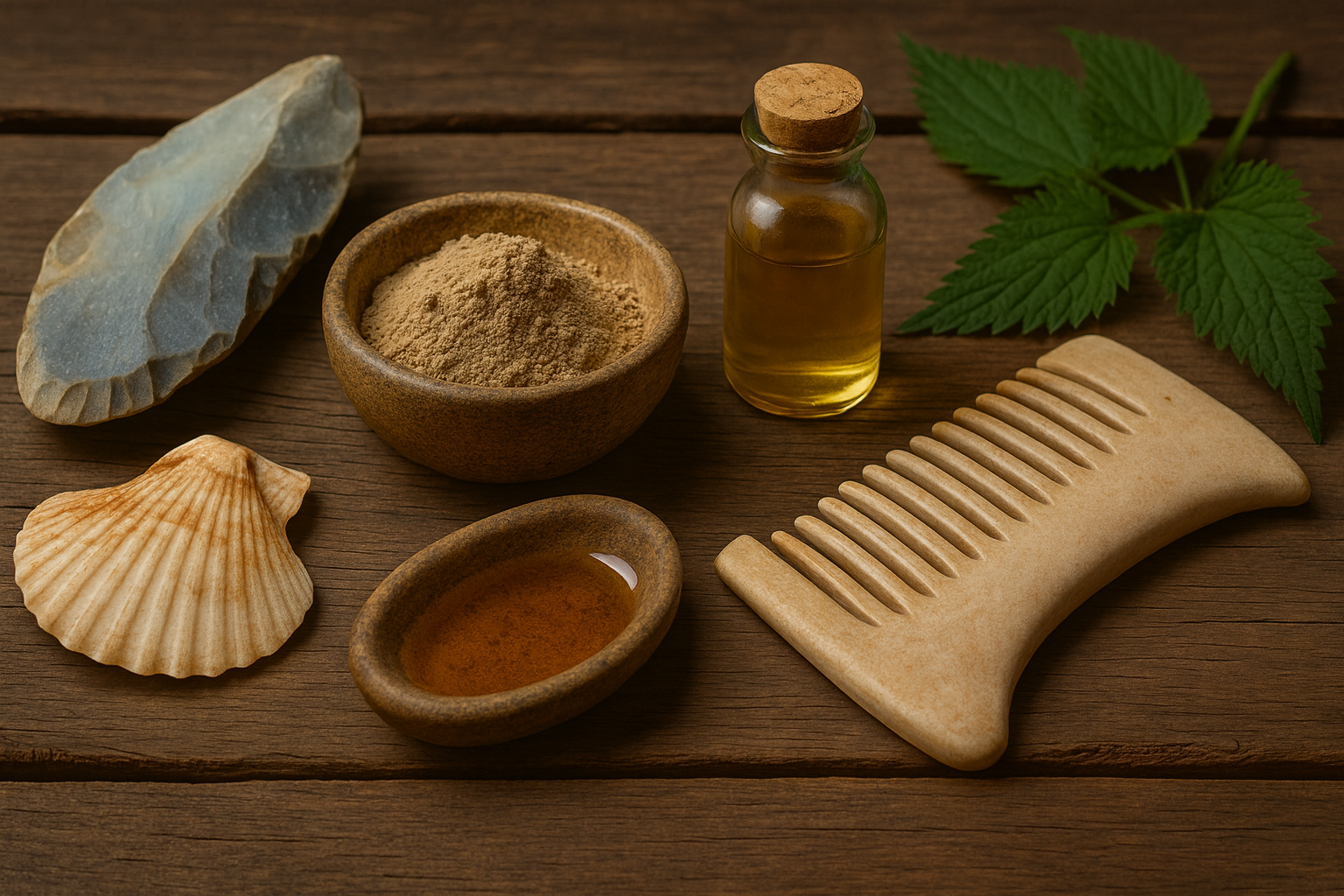
Without modern surfactants, the core idea remains: mechanically solve (Water, rubbing, combing) and Binding fat (e.g., through clay/soil). Ash is well documented as a Stone Age material – but its use in itself does not automatically mean "shampoo".
- Water + thorough rinsing
- Clay/Earth as an „oil binder“ (varies greatly by region)
- Combing/Fingering as daily „care“ (detangling, removing dirt, distributing natural oils)
Ash can be highly alkaline and irritate the skin. As a "historical idea," it's fascinating – but for home use on the scalp, it should be treated with extreme caution (and is not recommended for sensitive skin).
Detangling & Styling – Braiding instead of blow-drying
Many modern styling goals have always existed at their core: order, support, symmetry, texture. Braiding, tying, sectioning – this can be achieved with hands, cords, leather straps, or plant fibers.
Unravel: Start with your fingers, then (where available) with a simple comb/tool. Always: from the ends upwards.
Fix: Bundling lengths (braid, knot, wrap) – practical for work, warmth and less friction.
Structure: Sectioning and braiding patterns create a "look" without the product – and often last longer than loosely worn lengths.
Jewelry: Pearls, bones, stone, wood – if available – instantly transform function into status/story.
Resins/tars and similar substances have been used since the Stone Age. Adhesives Clearly documented – for example, for attaching tools. Whether it was also used to „fix“ hair is considerably harder to prove – but the material properties (sticky, malleable) are there.
Cutting, shortening, removing – how was that done without scissors?
Hair can also be changed without metal tools: by Scrape (sharp stone edges), Fold/Break in case of brittle ends, or due to controlled shortening with very sharp blades. However, how widespread shaving really was in the Stone Age is disputed.
Stone as a blade
Flint/obsidian can form extremely sharp edges – good for cutting and scraping, but delicate and not „comfortable“ like modern tools.
More "function" than perfection
Many things were probably pragmatic: shorter if it was bothersome; tied together if it rubbed; protected if it was freezing.
Shaving: possible, but not definitively proven
Smooth faces in prehistoric art are sometimes interpreted as shaving – but this remains speculation and varies greatly regionally and chronologically.
Ötzi as a reality check: What remains complicated even with "top finds"
Ötzi (Copper Age) is one of the most famous individual cases. Interestingly, different interpretations of his remains produce different results. Museum records mention tufts of hair that suggest dark, medium-length hair, while more recent genetic analyses indicate significantly advanced hair loss. This shows that even with very well-preserved finds, interpretation remains a part of the truth.
If details are already being discussed regarding Ötzi, this applies even more so to "the Stone Age" in general: It's better to explain clear principles – instead of claiming "that's definitely how it was".
Mini „Stone Age“ care plan (modern approach, no nonsense)
Drawing inspiration from history – but remaining practical and gentle on the scalp: that's the key. Here's a simple plan that translates the basic logic (gentle, regular, low friction) into today's context.
Daily: Briefly unravel, air out the parting/root, loosely gather lengths together where there is friction (scarf/collar).
Weekly: Clean gently, rinse thoroughly, condition lengths (where necessary) – without producing „build-up“.
Always: Less heat, less pulling, more technology. That's the "luxury" that Stone Age hair care didn't have – but we do.
Salon Update: Cut/structure your hair so that it falls better "by itself" in everyday life – instead of fighting it every day.
Checklist: What really helps (then and now)
Whether you live in the Stone Age or in the city: hair gets better when you don't overload it – but treat it properly.
- Gently unravel (ends → lengths → base)
- Reduce friction (keep an eye on collar/scarf/jacket)
- Rinse thoroughly (less film, fewer knots)
- Fixing with technique (braiding, wrapping, clips) instead of with "more and more product"„
FAQ: Frequently Asked Questions
One thing is certain: water, rubbing, combing, and materials like clay/earth are obvious choices – and similar principles are well documented historically and ethnographically. However, the exact "routine" varies depending on the region, time period, and way of life.
Modern products: no. But "fixing" is also possible without them: braiding, tying, knotting, jewelry – and possibly spot-sticky natural substances (although direct evidence on the hair is rare).
The Stone Age logic is surprisingly modern: less friction, thorough rinsing, technology instead of force. In salons, this is precisely what is refined – only with better tools, better formulas, and more predictable results.
Conclusion: The tools change – the basic idea remains.
Hair has always been more than just "there." Whether for protection, everyday life, or expression: even without shampoo and scissors, solutions had to be found. Today, the advantage is that we can apply the same principles with professional methods so that hair stays healthy and still makes a statement.
Do you want to give your look a modern twist?
If you like, we can look together at: What structure does your hair need so that it stays in place more easily in everyday life – and styling doesn't become a daily chore.
✨ Book an appointmentTip: Feel free to bring a photo of your "everyday problem" (knots in the neck, frizz, lack of shape) – then we will incorporate the solution into the cut & routine.